



Owing to the current energy crisis and extreme changes in the global climate, much attention is being paid to the finding of renewable energy resources. Vast progress has been made in the development of new materials related to renewable energy and their physical/chemical properties can be tailored by nanostructuring and other advanced synthetic approaches. In many important energy systems such as solar hydrogen systems, the atomic/electronic structures of materials and fundamental phenomena of system critically determine the energy conversion efficiency of materials [1,2]. Without knowledge of the fundamental electronic structures of the materials during conversion reaction, better engineering of the material for practical use is difficult. Understanding and controlling the interfaces in energy generation/conversion/storage materials requires in-situ/operando approaches [3,4]. The Taiwan Photon Source (TPS) Soft X-ray Spectroscopic beamline provides the capabilities for X-ray absorption (XAS) and X-ray emission (XES) spectroscopies, which can be utilized to investigate unoccupied (conduction-band) and occupied (valence-band) electronic states, respectively. Moreover, resonant inelastic X-ray scattering (RIXS) can be used to study intra-band (including d-d or f-f excitations) and inter-band (charge transfer) transitions [5,6]. The former provides details about electronic energy splitting in various crystal fields and the latter involves electron transfer between a metal and a ligand, which determines chemical activity [7,8].
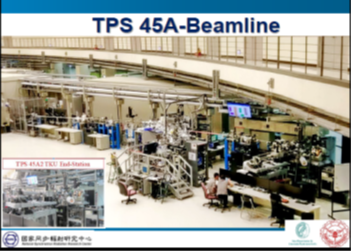
Soft X-ray spectroscopy at TPS 45A is expected to be the subject of renewed interest, particularly, owing to the new research opportunities that are provided by the high brightness and high performance of the instrument [9]. The TPS 45A beamline initially was proposed by three major Institutes- the National Synchrotron Radiation Research Center (NSRRC), The Max-Planck Institute (MPI) for the Chemical Physics of Solids in Dresden, Germany, and Tamkang University (TKU). A 3.8 m EPU46 undulator was installed in the 7 m-long straight section in this beamline as the photon source. Figure 1 displays the layout of the TPS 45A beamline. A deflection mirror at this beamline devises two end-stations, which are dedicated to soft X-ray angle-resolved/angle-integrated photoemission (PES) and XAS/XES/RIXS measurements will primarily utilize by MPI and TKU groups, respectively.
The TKU branch is considerably used for making high photon flux XAS and XES/RIXS measurements. It is therefore designed to have a photon flux of greater than 1×10¹² photons/sec. The beam size at the sample is approximately 3μm×3μm (H×V). A high-resolution emission spectrometer-variable line spacing (VLS) grating spectrometer was installed at the TKU end-station. Two gratings (9000 and 18000 lines/cm) were used; the low-density grating covers photon energies from 250 to 500 eV, while the high-density grating covers photon energy up to 1200 eV. The resolving power is optimized at two target photon energies, 285 eV (C) and 640 eV (Mn), and is approximately 5000. As presented in Fig. 2, the TKU end-station provides an in-situ electrochemical and gas/liquid reaction cell and provides unique possibilities for making in-situ XAS and XES/RIXS measurements.
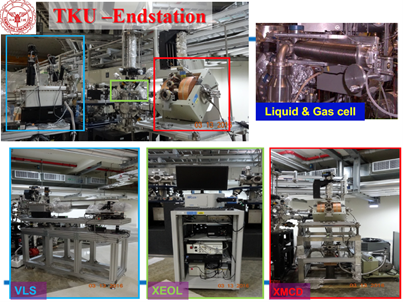
The TKU end-station is also equipped with XEOL (X-ray Excited Optical Luminescence) and XMCD (X-ray Magnetic Circular) facilities, as also presented in Fig. 2 (XEOL facilities were collaborated and constructed by Dr. Y.M. Chang/NTU). XEOL is the emission of optical photons following the absorption of X-ray of a selected energy, often across an absorption edge. XEOL spectrum tracks optical emission following X-ray excitation. It differs from conventional photoluminescence (PL) in that it preferentially excites the core electrons of a specific atom in a particular chemical environment, access to highly excited states and the thermalization of the photoelectrons/Auger electrons and holes in the system of interest primarily contributes to the luminescence. XEOL has been demonstrated as a powerful tool for tracking the efficiency of a luminescence channel across absorption edges of atomic-site specificity, especially in the soft X-ray region [10,11]. The main difference between the XEOL and PL techniques is the incident energy/wavelength in the former is adjustable, while in the latter technique; only a single incident wavelength can be used. X-ray is strongly penetrating and it can be used to study the bulk nature of a material. The incident photon energy can be selected and scanning at a specific absorption edge to elucidate the correlation between luminescent defects and associated electronic structures.
XMCD is also an extremely powerful method for studying materials that exhibit ferromagnetic coupling. The elemental specificity and chemical sensitivity make XMCD unique. The XMCD facility in the TKU end-station is composed of a coil magnet (GMW magnet) that is controlled by a bi-polar power supply, and a compact UHV chamber, as presented in Fig. 2. The magnetic field that is generated at the sample can be rapidly flipped from between +2T to -2T within 500 ms. The sample holder has an electrical contact so the XAS spectrum could be recorded in TEY (total electron yield) mode directly from the sample. A metal mesh behind the sample holder enables detection in transmission mode. The transmission mode is particularly useful for an insulating material or a material without good electrical conductivity. Temperature-dependent XMCD can be used with two options. Liquid nitrogen cooling uses a general-purpose sample holder, in which can be loaded several samples at once. A liquid helium cryostat is also used to make measurements at temperature ranges of ~20 K.
References:
1. S. Shen et al., Energy Environ. Sci. 9, 2744 (2016).
2. J. Chen et al., J. Mater. Chem. A 2, 4605 (2014).
3. V. Iablokov et al., Nano Lett. 12, 2091 (2012).
4. F. Zheng et al., Nano Lett. 11, 847 (2011).
5. S. M. Butorin et al., Phys. Rev. Lett., 77, 574 (1996).
6. P. Kuiper et al., Phys. Rev. Lett. 80, 5204 (1988).
7. H. Liu, Nano Lett. 7, 1919 (2007).
8. V. Bisogni et al., Phys. Rev. Lett. 114, 096402 (2015).
9. D. Huang and S. Chang, Synchrotron Radiation News 27, 10 (2014).
10. J. Chiou et al., J. Phys. Chem. C 116, 16251 (2012).
11. S. Singh et al., Nanoscale 6, 9166-9176 (2014).

(A-Core Plus子計畫主持人)
►研究領域 : 同步輻射、固態物理、奈米/能源材料
► 辦公室:新北市淡水區英專路151號彭維鋒研究室(科學館S308)
► 電話:分機2820 / 02-26252333 / 02-26215521
► 電子信箱:wfpong@mail.tku.edu.tw

►研究領域 : 固態材料領域
►研究專長 : 固態材料、同步輻射
► 辦公室:理學院大樓515研究室(C02-515)
► 電話:07-5919721 / 07-5919000 ext.7721
► 電子信箱:jwchiou@nuk.edu.tw


